Hey Fam,
I want to talk to you about some of the decisions I made when building NeuroRythm. Not the features. Not the roadmap. The underneath stuff. The stuff that doesn't show up in screenshots but shapes everything about how this product works and how I run this community.
Because I made some choices that go against how most software companies operate. And I think you deserve to know why. You can also visit our Questions page to know more.
WHY YOUR DATA STAYS ON YOUR DEVICE
When I was building NeuroRythm, I had a choice. I could build it the way most apps are built. Your data lives on a server somewhere, we analyse it, we use it to improve the product, maybe they use it for other things we mention somewhere in paragraph fourteen of the privacy policy. Maybe we sell it.
Or I could build it differently.
I chose differently. Everything NeuroRythm tracks, your sessions, your focus patterns, your habits, your progress. Stays on your machine. Not because it was the easy option. It wasn't. It was more work. I chose it because I genuinely do not want your personal data.
Here is what I actually collect: your email address and your install ID. That's it. Your email so I can talk to you. Your install ID so the system knows your licence belongs to you. No address. No phone number. No date of birth. No bank details. No profile being quietly assembled in the background.
I've been on the receiving end of data collection I didn't fully understand or consent to. Most of us have. You sign up for something, you tick a box, and somewhere a company you've never heard of knows more about you than your GP. I'm not interested in being that company.
There are two separate relationships happening when you use NeuroRythm. There's NeuroRythm the product, which genuinely does not know who you are beyond an email and an install ID. And there's me, JD the person, who is part of this community the same as you are and wants to know you as much as you're willing to share.
Those are not the same thing. The business has no claim on your personal details. What you share in the community is just you and me talking. It's not a data point. It's a conversation.
The reason I designed it this way isn't because I don't care about you as a person. It's the opposite. I care enough to make sure there's no transaction sitting underneath every interaction.
WHY AI IS ALWAYS YOUR CHOICE
I read a lot of AI newsletters. Occupational hazard. And there are days when I'm reading through them and I feel that creeping sense of "what's the point, everything is being swallowed by this."
Then I catch myself and go: hang on. That's not what I'm building.
A lot of software right now is quietly baking AI into everything without telling you. It just shows up one day, doing things, making decisions, and you didn't opt in to any of it. I find that disrespectful. Your brain is not a feature to be optimised by someone else's algorithm without your knowledge.
NeuroRythm will NEVER do that.
The only time AI is part of your experience is when you turn it on. You make that choice. You say yes to that specific feature, for that specific thing, and that's where it starts and stops. If you never want to use it, you never have to. Nothing in the core app requires it.
When AI is available for something, you'll see it. A clear toggle. On or off. Right there. Not buried in settings. Not defaulted to on. Your call, every time.
We'll keep adding AI-assisted features as the product grows. We will also make every effort to keep the models local as well. Every single one of them will be opt-in. That's not a current policy that might change. It's a founding principle. It's the whole point. There's a reason I haven't sought VC investing, nor ever will. I refuse to compromise my vision, or this community.
I built this for people whose brains already have enough going on. The last thing you need is software making decisions for you that you didn't ask it to make.
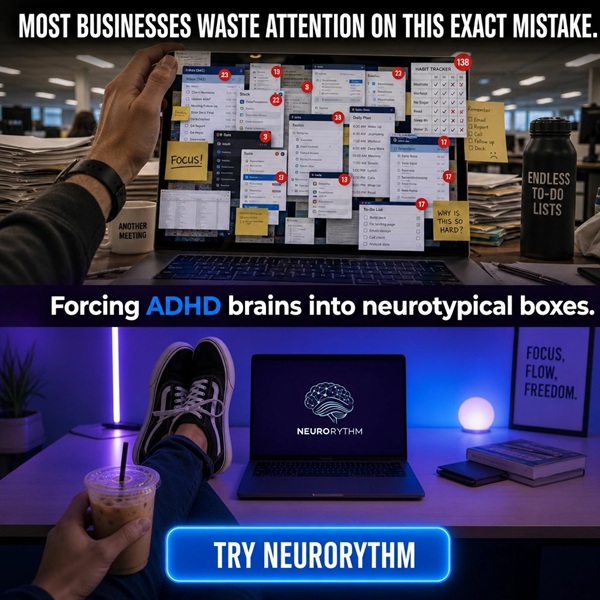
Standard software treats real life like a flawless calendar event. It doesn’t account for burnout, chaos, or how an ADHD brain actually manages focus.
WHY THE SUBSCRIPTION MODEL WORKS BACKWARDS FROM EVERYONE ELSE
How many times have you subscribed to something, forgotten about it, and then three weeks later seen a charge on your card and gone... oh for god's sake.
Yeah. Me too. More times than I want to admit.
The standard subscription model is built on that. It counts calendar days whether you showed up or not. It doesn't care that you had a rough week, or that your kid was sick, or that your brain just wasn't in it. The month ticked over and the money left your account.
That model does not count real life. It absolutely does not count ADHD.
So I built it differently.
First: there is no subscription to use NeuroRythm. One-time purchase. The core product is yours. Full stop.
The subscriptions that do exist are for optional add-ons: the Chaos Gremlin sound pack, AI-assisted features, and the future tools that you vote on at feature.neurorythm.com. These are niche tools that work with NeuroRythm, and some work independently as well. You choose them. You can ignore them entirely. NeuroRythm still does everything it's supposed to do without them.
And when you do subscribe to an add-on, you're paying for usage days, not calendar days. Your days don't drain while you're not there. Use it four times this month? You've used four days. The rest are waiting for you whenever you come back. Not gone. Not wasted. Still there.
But that's not even the part I'm most proud of.
I call it the We All Win Together model. Here's how it works. When the subscriber base hits a set milestone, when enough people have joined, the monthly price drops. For everyone. Not just new sign-ups. Everyone currently subscribed pays less. And if you've been paying at the higher price before that milestone hit, you get credited the difference for every month you already paid.
You believed in this early. You get rewarded for that.
The more people who join this community, the cheaper it gets for all of us. My financial success is directly tied to making this more affordable over time, not less. That is the exact opposite of how most software companies think, and I'm fine with that.
Everything is published live and openly on the Transparency Dashboard. The subscriber numbers, the pricing tiers, the thresholds. Nothing behind closed doors.
WHY SUPPORT WORKS THE WAY IT DOES
I built error reporting into the app because I know what it's like to hit a problem and then spend forty-five minutes trying to explain it to someone who sends you a canned response three days later. That's not support. That's performance.
If something breaks in NeuroRythm, I usually know about it before you've had a chance to wonder what happened. That's the goal.
When you do need to reach out, and the most common reason is the same reason I need support sometimes, which is that you went poking around somewhere and pushed something you probably shouldn't have, because same brain, support is easy to find. JD (that's me!) is in the community every day. There's a contact email on every page of this site. There's a form if that's easier. However you want to reach out, there's a way.
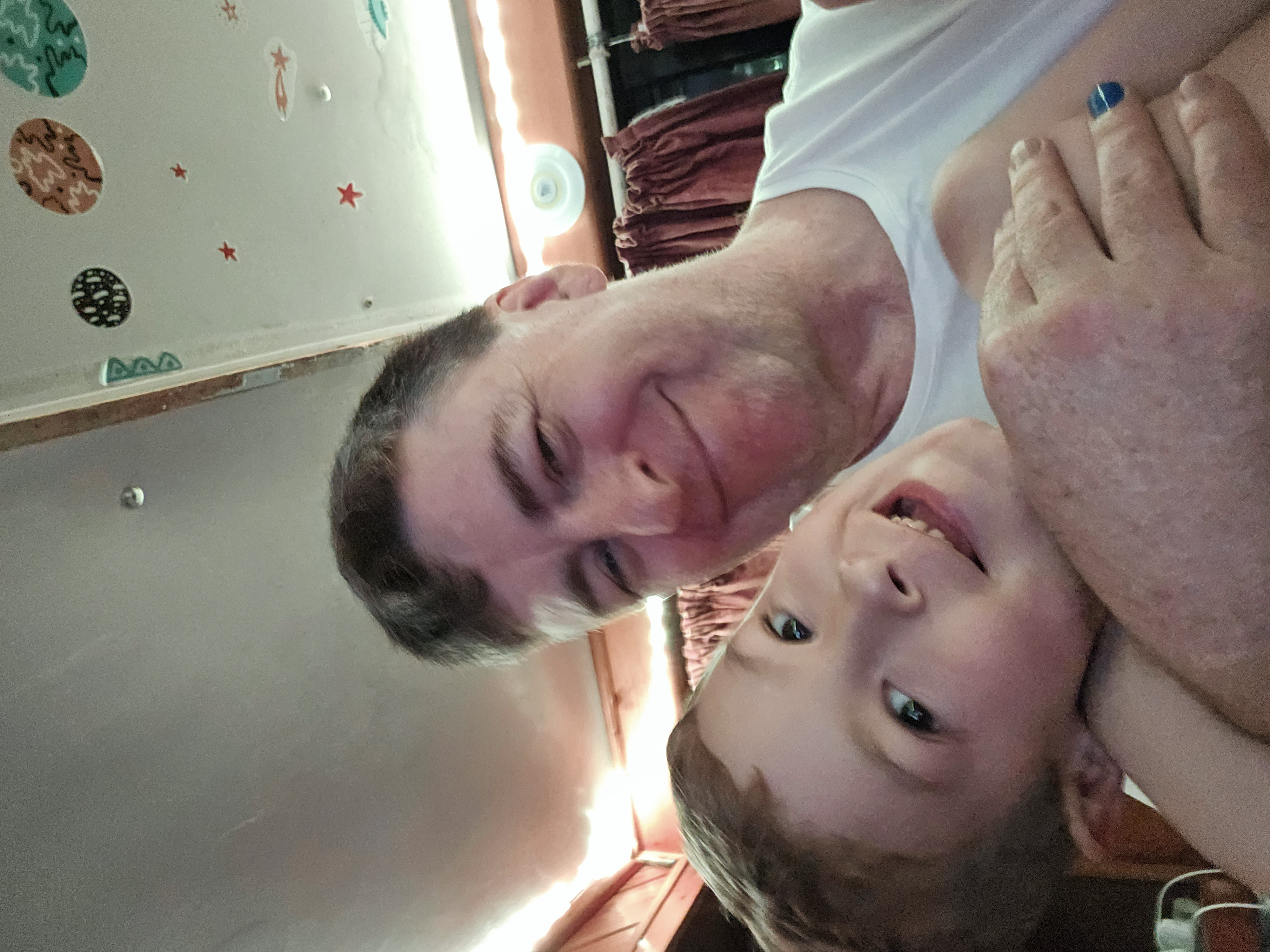
One thing to be honest about: I'm a single dad to a child with special needs, building this from Perth, which is comfortably the worst time zone in the world for fast responses. I will always get back to you. Always. But if it's 3am my time, it might not be instant. I ask for your patience on that, and in return I promise you'll hear from an actual human who gives a damn.
Because here's the truth. Without you, I'm just a bloke playing with code as a hobby. This community is not a marketing strategy. It's the whole reason any of this exists.
Your trust, your privacy, your data, and the support you need are not afterthoughts. They are the entire damn point.
That's why I built it this way.
JD

💬 Comments
Leave a Comment