It was supposed to be an hour and a half.
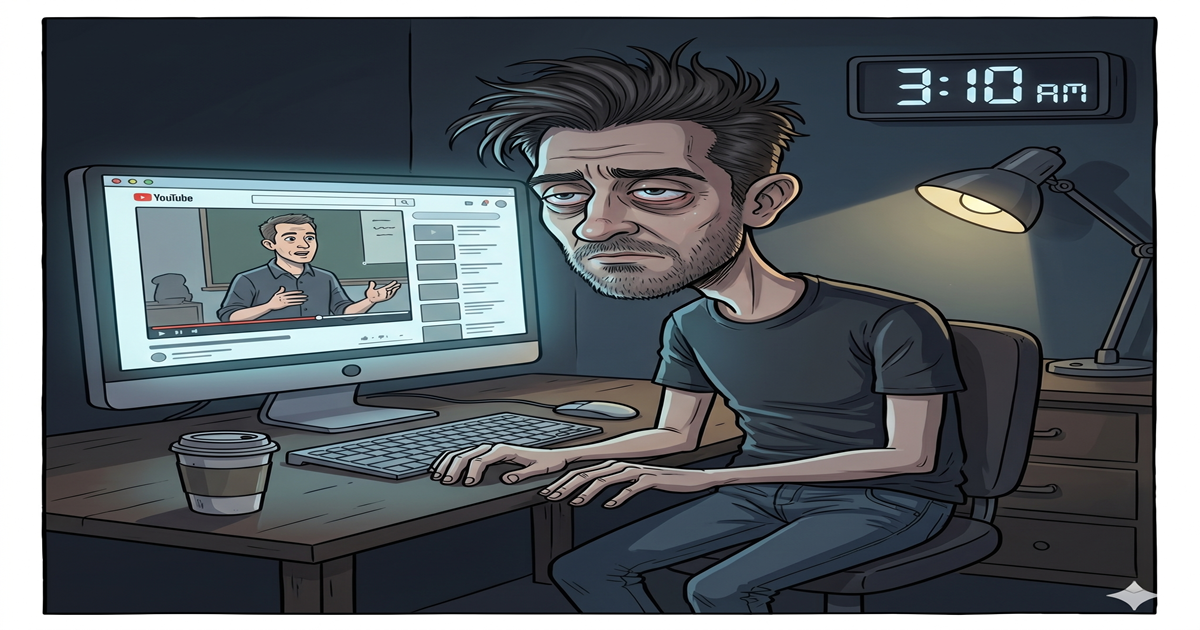
I sat down at 12am with good intentions. A course that had sparked my interest. Free. Something practical. Something that might actually make a difference for me and my son. Hour and a half, finishing up by 1:30am. I was usually still awake then anyway, trying to get to sleep, but the mind doesn't stop.
Nearly three hours later I finally closed the laptop. Not because I stopped caring. Not because I lost focus. Because the thing just... kept going. And I kept watching, reminding myself why I was doing this. It was after 3am when I finally hit the pillow, brain still wired from the activity of the previous 3 hours. Telling myself, if I went to sleep now, I'd get nearly fours sleep. Then, if I went to sleep now, I'd get nearly 3 hours sleep. At some point after that I finally fell asleep.
11:00 AM — How the ADHD Shame Spiral Starts
Woke up at 11am. Fuck. Before I'd even fully opened my eyes, it had already started. Bad dad. Should've been up hours ago. Look at you. Can't even get up in the morning. Your son is supposed to have been at school nearly 3 hours ago. You're a mess. Unorganised, always late. What the fuck is wrong with you?
That's the thing about the spiral. It doesn't wait for you to be conscious. It's already running. Doesn't let logic speak up. Doesn't care about intent.
I lay there for a minute doing the thing I always do... cataloguing the damage. Working out how wrecked the day was before it had even started. Calculating how far behind I was. How many things I'd failed before breakfast.
I got up anyway. School was out for the day. Getting him ready, and the to school. I'd come home just in time to leave to pick him up. Pointless. Grabbed a drink and sat down at the PC, just staring at the monitor.
When a Task Manager Feels Like "Shame with a Button"
NeuroRythm was running. As it does. No alarm. No flashing notification. No list of everything I hadn't done yet. Just one thing on screen.
"Past Due Recurring Task. How did this go?"
I sat there for a second, staring at the options. Dismissing it wasn't going to cut it. Just clicking past it felt like a lie. Like the night before didn't happen. Like it doesn't count, move on, pretend.
But it did happen. And there was a reason it happened. A real one, a VALID one
I stayed up until 3am participating in a course because I'm a single dad trying to build something from nothing, living in a converted bus, raising a nonverbal autistic kid, running multiple brands, building software with no coding background. I was up at 3am because I'm trying to make our situation better. Not because I'm broken. Because I give a shit. Also, I swear I live in the worst time zone on the planet. This course had been the best scheduled one for a long time, I had to give it a shot.
The popup though? Dismiss with no record isn't data. It's just... shame with a button. Because a month from now, I won't remember the why, but I'll see an email about the course, and all I will remember, is failing at another thing.
I built NeuroRythm from a core feeling of... fuck that. No more.
So I didn't dismiss it. I built the fix instead. I fixed the system that keeps kicking us while we are down, insisting it's us that is broken. Expecting the awesomeness of our brains, to fit in the little container with a label, like everything else the system does.
Introducing the "Life Disruptor": Reframing Productivity for ADHD
I had already built the Life Event Pause button. It's function, when a major life event occurs, you hit that. The entire system is paused until you come back. No notifications, no sound, no popups. Nothing. Because life happens. A family wedding to attend away. Family vacation. Unscheduled hospital visits, I know about those. You don't need constant reminders of your plans that you made, with intent, reminding you, mocking you. You need peace, guilt free time to deal with whatever it is. You return, take the system off pause, record the data of the event so future you has the context. Back into it again.
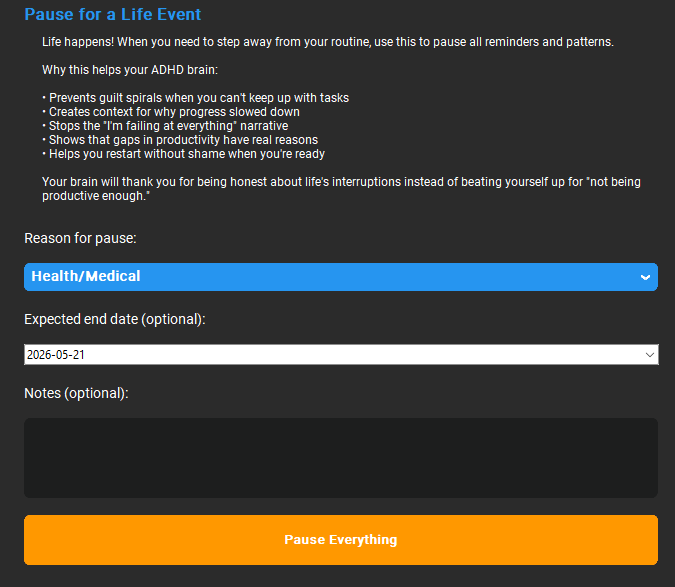
Guilt-free peace when life gets heavy. Hit pause, deal with reality, and return without a backlog of failures mocking you.
That function had been there for some time. I now saw that there was a gap. The Life Events are for events you know are coming, or are happening, as you hit that pause. What about the events that just happened, that derailed you for half a day? Nothing to record the context so you have that clarity a month or two down the track.
Now there is. Life Disruptor button. Records the data of the disruption, you enter that context to remind you. So that you aren't beating yourself up a week later. I spent a week in hospital last year. I hadn't even been home a week and I was frustrated, told my friend I was sick and tired of always getting distracted, doom scrolling, trying to force myself to do the thing and brain kept saying NOPE. I'm more than a week behind on what I'd scheduled.
My friend was like. Duh, you were in hospital for a week.
I pause, look at them like they were the crazy one. OH.. yeah, I was, wasn't I? ADHD didn't care about that, it had decades of external and internal critics much louder than the context.
Life Disruptor. Record what actually happened. Why it happened. Let the system silently tag the affected blocks so you've got context, not condemnation. No "you missed X things." No shame summary. Just... this happened, here's why, now keep moving. This gets it out of your head, reframes it, your day isn't ruined, you just had a hiccup. The rest of my day, ended up being a pretty good day.
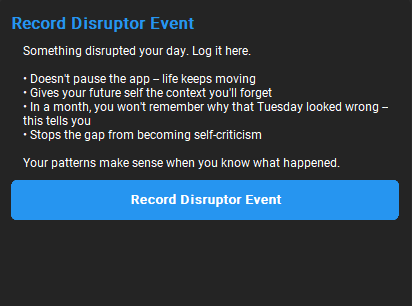
Context, not condemnation. The new feature built to capture the mid-day hiccups before the shame takes over.
Eventually Patterns and Insights will surface what that data actually means. Not as a failure report. More like... "when you take on late night commitments, your next morning block is affected most of the time." Something you can actually use. Something that treats you like an adult who's managing a complicated life, not a student who needs to be corrected.
That Internal Critic? That Voice Isn't Yours
I want to say something clearly, and bluntly. We all need to fucking hear this.
That internal critic you've got... the one that always starts in on you, every second it can. The one that is harsher than any external critic ever was. It's not your voice. You didn't build it. You inherited it. If you can, next time you hear it, try and sit quietly with it. You will notice that you might even recognise some of it.
It's the accumulated opinions of forty years of people who didn't understand how an ADHD brain works and decided that meant something was wrong with you. Teachers who called you lazy. Parents who said you just needed to try harder. Employers who had no idea what executive dysfunction even was. Partners who took your inconsistency personally. Anyone in a position of authority, earned or not, that just loved to lay the blame at your feet, not even an attempt to understand.
They weren't bad people, most of them. They just didn't know. And in not knowing, they handed you a script that your brain, because it's an ADHD brain, held onto way longer than it should have.
That voice has never been the truth. It's just the loudest thing in the room.
You know what the truth is?
Late night overcommitment leads to a missed morning. Missed morning leads to shame. Shame compounds into a wrecked day. Wrecked day affects sleep. Affected sleep compounds the next morning. Round and round. The ADHD shame spiral isn't a character flaw. It's a documented pattern. It's not evidence that you're broken. It's just what happens when a specific kind of brain meets a world that was never designed for it.
Why NeuroRythm Works Differently
It's not a list of tasks on a panel. It does have a task panel though, and a manager. Manager in deed, not just it's name. Because typical Task Managers? I don't care about task managers. The world is full of task managers. Most of them make ADHD worse, not better.
NeuroRythm is an interrupt. It's designed to hit the spiral at the exact point where it does the most damage... before the shame compounds into a lost day. One thing at a time. No screaming. No list of failures. Just a check-in.
"Past You recurring task. How did this go?"
That's it. And in that one question, there's a different assumption buried. Not "why didn't you do this" and not "you failed again." Just... what happened? Let's record it. Let's give it context. And then let's move on.
You get rewarded for responding. Because that's what builds a streak. No shame, just data and context, you are building your patterns with your data, to bring you and your brain into alignment. Learning new pathways, to work with your brain.
The rest of that day could have been a nothing day that would have contributed to the shame spiral. I've had plenty of days, that became nothing. You probably have too. The spiral takes hold and suddenly it's 4pm and you've done exactly zero useful things and you feel worse than you did at 11am and the whole day is just... gone.
Instead I built something. I built it because I needed it. That's all throughout NeuroRythm, every feature, function, behind the scenes processing, all derived from an ADHD pain point, and me looking at it differently. Instead of what is wrong with me? What's wrong with this system and how do I change it to suit me?
That's all it takes, sometimes. One thing on screen. No screaming. Just... what happened?
If this has resonated with you, as I am sure we've all had similar experiences, probably most days as well. NeuroRythm is in early access stage, 50% off regular pricing. It's a one time purchase, you own it. I built this because I needed it, so lifetime support and updates. I know, we've heard that before. But I'm not going anywhere.
And I get it. What makes this different? We've all had apps and processes that have promised us the world, and end up on the graveyard pile within a few weeks. I talk about that in my first article - 663 Apps Couldn't Fix My ADHD Brain. So I Built NeuroRythm.
So you can join our community, were you can talk with me directly, ask any questions, see clips of the app in the process of being used, talk with others who are using NeuroRythm.

💬 Comments
Leave a Comment